News
Boeing and Carbonfuture Sign Multi-Year Agreement for at least 40,000 Tonnes of Durable Carbon Removal
Boeing and Carbonfuture Sign Multi-Year Agreement for at least 40,000 Tonnes of Durable Carbon Removal
Learn More


Article
by
•
July 23, 2026

Europe is on track to integrate carbon removals into the biggest carbon compliance market in the world, the EU Emission Trading System (ETS). I would argue that this is the biggest achievement in carbon removal policy to date.
Ever since the European Commission’s proposal dropped on Friday the 17th of July, feeds have been filled with reactions. In this article, I want to cut through the noise and provide you with an in-depth analysis of what this really means for CDR.
Integrating CDR into the EU ETS has long been an obsession of mine. I wrote about it here in 2023, have covered it no less than 121 times on my LinkedIn, published a peer-reviewed research paper on it, and spent the last week of my life doing little else than disentangling the current proposal, including having an AI read out the entire thing to me on a long car ride (before you ask, it took 6.5h on 1.5x speed, only for true EU policy masochists). Finally, I had the great pleasure of hosting Mette Quinn, the Deputy Director for Carbon Markets and Clean Mobility at the EU Commission and pen holder on this proposal, on the CDR Policy Scoop yesterday (Podcast & YouTube).
Sure, us working in CDR have been dreaming about this day for years. But why would Europe actually pull the trigger on it? There are a number of reasons. First and foremost, the EU ETS has come under significant attack lately, with senior political figures even asking for its abolishment. As a result, the Commission has been keen to introduce “flexibilities”, including CDR. Another key aspect is that CDR can de facto create a “safety valve” and prevent carbon costs spiralling out of control. Finally, but least importantly I would argue, the EU has recognised that it needs to scale the CDR market somehow and this seems like an obvious avenue.
The Commission’s own estimate is that they would buy 250Mt of CDR with a budget of €35.7b-€55.5b between 2031 and 2040. Why such a big range? The funding would come from the sales of 250 million EU Emissions Allowances, or EUAs, the price of which are hard to forecast. Currently, they stand at around €80, so the budget would be €20b as of today. By design, EUAs are supposed to get more expensive and the Commission assumes that they will cross €200/EUA sometime in the late 2030s. So, on average, they plan to buy a tonne of CDR for each EUA they sell. Purchases will be made directly by the Commission in the form of offtakes, potentially with a small upfront payment, and the rest paid on delivery. The first offtakes could happen as early as 2031 and the exact method (tendering, reverse auction, or flat-rate price) is tbd.
For now, the Commission recommends only using Direct Air Carbon Capture and Storage (DACCS) and Bioenergy with Carbon Capture and Storage (BioCCS or BECCS) certified under the EU Carbon Removals and Carbon Farming (CRCF) regulation, supposedly primarily due to the pre-existence of monitoring and liability regulation (CCS Directive). Notably, the third permanent CRCF methodology - biochar carbon removal (BCR) - was not included despite a very favourable assessment by the Commission itself (see page 61-68 of the Impact Assessment), a decision which has already been questioned publicly by the lead Member of Parliament negotiating this file. De facto, despite its stated goal to promote tech neutrality, we are seeing a proposal which relies almost exclusively on a single technology: BioCCS.
In my view, this proposal has a clear Achilles Heel: its CDR cost assumptions. Frankly, I am simply baffled by what the Commission has put forward here. The cost assumptions for BioCCS, on which this entire proposal relies, could be off by a factor of two. This leads to an assumption that BioCCS will cost sub-€200/t by 2036 and therefore become cheaper than an EUA. A reminder: unsubsidised BioCCS currently costs >€300/t. Cost savings will exist, especially on transport and storage, but unlikely to be -50%. Similarly optimistic assumptions are made for DACCS. For BCR, the inverse is true, where impossibly low estimates - €37/t BCR anyone? - lead to the conclusion that BCR would be too cheap and crowd out everything else.
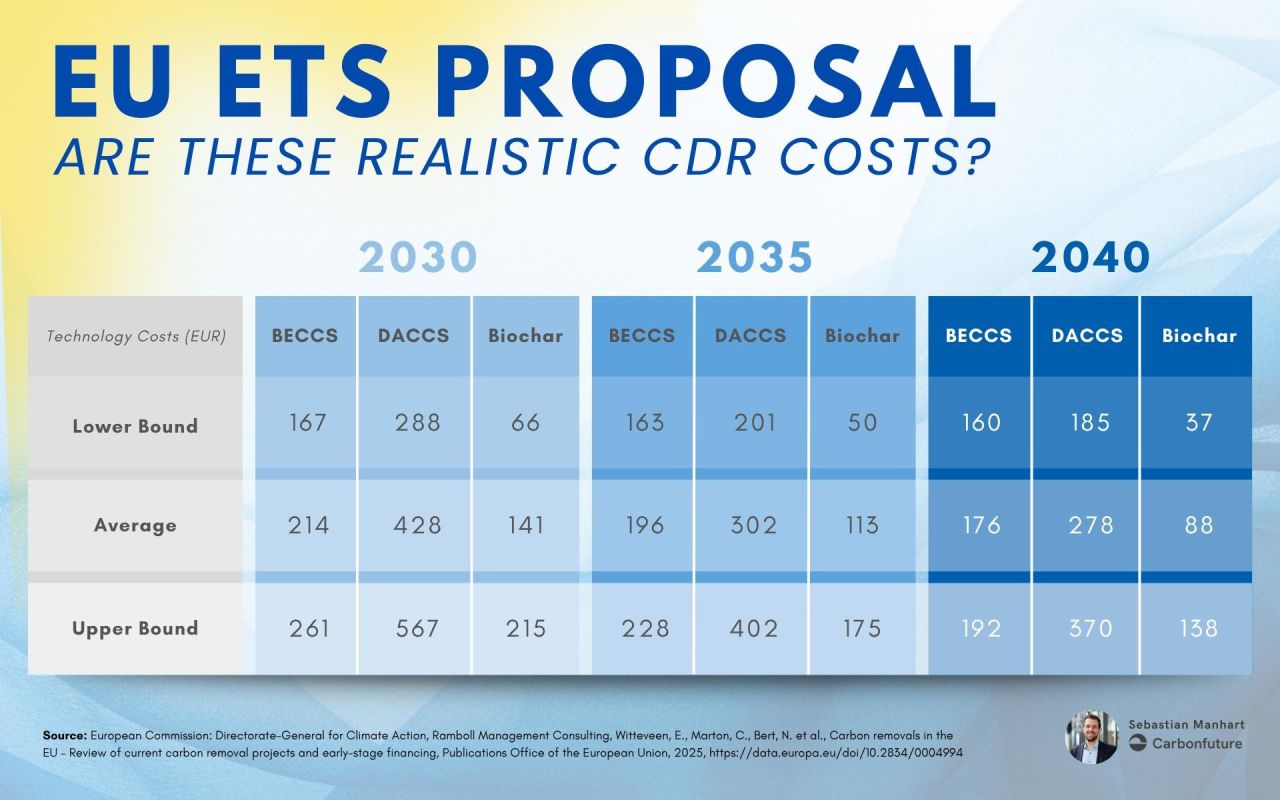
Assuming these numbers are off (which I really believe so), this leaves a few options:
Option #1 is unlikely in the short term, although the Commission is supposed to present a report on progress towards the CDR purchasing by 31.12.2034, and has suggested requesting additional funding then should the estimated budget fall short.
Option #2 is highly problematic and would lead to wide-scale criticisms.
Option #3 seems the easiest solution to this impasse, and one that could be realised with relative ease and soon.
Beyond the core mechanism mentioned above (auctioning of 250M EUAs + 10M EUAs contingency), there are a few other avenues for CDR in this proposal worth mentioning. If a regulated operator (say, a biomass power plant) builds its own BioCCS and captures its own emissions, that specific operator can use the removals directly for its own ETS compliance obligations. This can start in 2031 and its volumes are not capped, but will be deducted from the overall 250Mt budget.
The proposal also introduces two key funding mechanisms: the ETS Investment Booster (pre-2031) and the Industrial Decarbonisation Bank (post-2031). Both could, in theory, support CDR projects. The way it is currently phrased (tied to Annex 1 ETS facilities only), would de facto only allow BioCCS/BECCS projects to be eligible. The proposal also encourages member states to use some of their ETS revenues to fund a range of activities, including CDR, but this is a very loose and unlikely avenue.
Fairly controversial and late to the party, international credits found their way into this proposal. Again, as a “flexibility”. The Commission proposes to use the revenue from 260M additional EUAs to buy an equivalent amount of international credits between 2036-2040. What type? For now, it just says Article 6 with some additional requirements, although we expect a proposal by the end of this year with a clear recommendation from the Commission. This opens another significant opportunity for CDR, especially from the Global South. Purchases for these international credits are going to start in 2031, with a review to be published by the Commission by 31.01.2033 to assess whether there will be sufficient credits of the right type available for this.
This proposal is the starting point, not the destination. Next, the EU Parliament and Council will form their own positions on this proposal, hopefully by the end of the year. We will then enter the trilogues, which should wrap up in 2027 (quick EU policy refresher here). By the end of 2028, it should be transcribed into national law across all member states for entry into force in January 2029. First offtakes and purchases can be expected in 2031, with volumes ramping up gradually throughout the 2030s.
This proposal marks a step change for CDR. The transition from voluntary to compliance markets is finally here, and we now have a clear idea of how the world’s regulatory trailblazer - the EU - is planning to approach it. While there are still many rough edges that need to be ironed out, this is going to happen, and its impact on our industry will be sizable.
I expect repercussions well beyond Europe, as we see other compliance markets and carbon pricing systems take notice and emulate this approach, starting with Switzerland and the United Kingdom. Now it’s time to work with regulators to ensure the final outcome is as catalytic for the industry - and the climate - as we are hoping for.

At Carbonfuture, we build trust throughout the carbon removal journey with our rigorous, data-driven approach, ensuring unmatched quality and reliability of carbon removal.